

Participants can choose their own translation language, while automatic detection handles multilingual conversations. Access depends on the meeting host’s plan and Google’s phased rollout.
Google Meet is expanding speech translation to 63 languages, giving participants more flexibility to follow conversations in their preferred language.
Announced on October 22, 2026, the update uses Gemini 3.5 Live Translate and supports the web, Android and iOS. It replaces the previous approach of choosing one language pair for an entire meeting with individual translation controls. Meet can also detect when speakers change languages.
For multilingual teams, the practical benefit is choice. Participants no longer need to share the same translation preference simply because they are attending the same call.
How Google Meet speech translation works
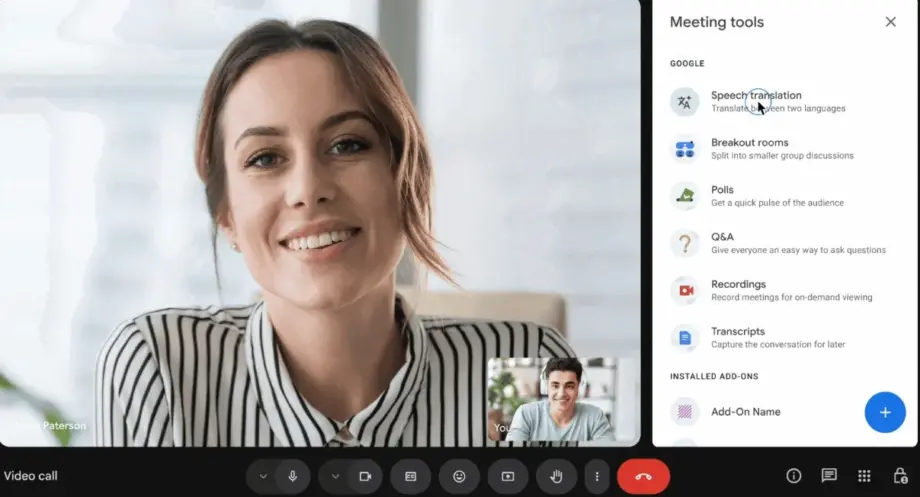
On desktop, participants can open the captions and translation control, choose Translate speech, and select their listening language. Captions can be enabled alongside translated audio.
Speakers must consent to having their voice translated. Google says translations arrive a few seconds behind the original speech, so “real-time” does not mean an instant, delay-free conversation.
That delay changes the rhythm of a meeting. Leaving a brief pause before responding should make exchanges easier to follow than speaking over a translation that is still playing.
Which Indian languages are supported?
Google’s supported-language list includes Bengali, Gujarati, Hindi, Kannada, Malayalam, Marathi, Tamil, Telugu and Urdu, alongside English and other languages.
This could be useful for teams working across Indian states and international offices. Language support alone, however, does not establish that every account or meeting can access the feature.
Who gets access, and when?
Eligible subscriptions include Business Standard and Plus, Enterprise Standard and Plus, Frontline Plus, Google AI Pro and Ultra, Google AI Pro for Education, AI Expanded Access and AI Ultra Access.
For scheduled meetings, an eligible host can make translation available to participants, including external guests. In direct one-to-one calls, either participant can supply eligibility.
Translation lasts up to 90 minutes per meeting on eligible base Workspace and Google AI Pro plans, or eight hours with AI Expanded Access, AI Ultra Access and Google AI Ultra.
Rapid Release rollout began October 22, with visibility expected within one to three days. Scheduled Release rollout starts November 2, taking up to 15 days. Mobile users need an updated Meet app.
Important limitations before your next call
Google Meet hardware supports listening to translated remote participants, but speech from the conference-room hardware is not translated for others.
The feature also excludes recordings, livestreams, client-side encrypted meetings, dial-in calls, third-party interoperability calls and adaptive audio. Regional and age restrictions apply.
Google warns that translation errors, unclear words and network-related quality problems can occur. It says speech-translation audio is not saved and voices are not used to train models.
For important decisions, participants should confirm names, dates, figures and action items in writing. A translated conversation can help people participate, but agreement is easier to verify when the key details are also visible in chat or shared notes.