


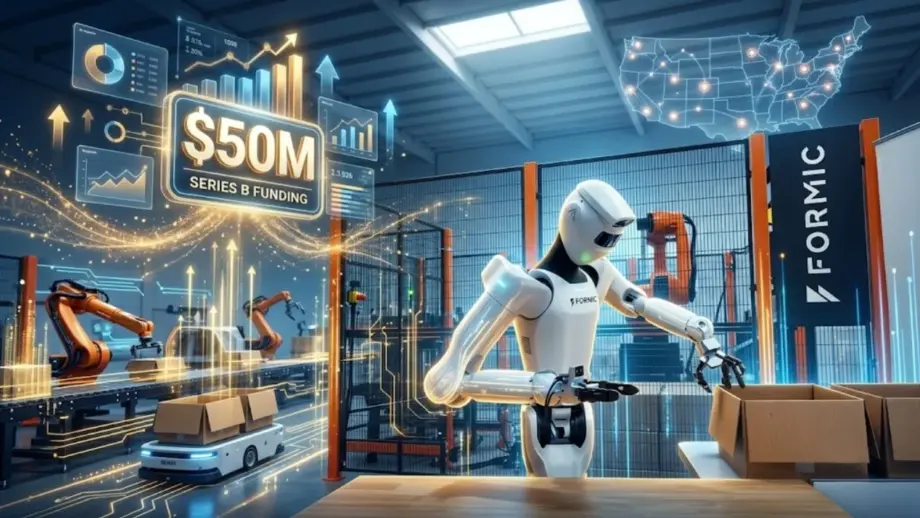
The financing combines a Mercato Partners-led Series B with debt funding as Formic moves toward robots capable of handling a broader range of manufacturing tasks.
Formic announced $50 million in growth financing on October 22, backing its expansion from specialized factory automation into general-purpose robotics.
The package includes a Series B led by Mercato Partners, with participation from Light Ray Ventures, Lightscape Partners, Citi and other investors. S2G Investments provided debt financing. The announcement does not disclose the division between equity and debt, so the full amount should not be described as a $50 million Series B alone.
For manufacturers, the development concerns more than increasingly capable robots. It also puts attention on the installation, maintenance and financing needed to make those machines useful on a working production line.
What Formic plans to expand
Formic says the capital will strengthen its AI and robotics capabilities, support applications such as metal fabrication and broaden its industrial reach.
Its existing fleet has accumulated more than 750,000 production hours across over 100 facilities in more than 30 states, according to the announcement. Formic also reports 99.6% fleet uptime and a 97% customer renewal rate. These are company-reported figures, not independently verified performance measures.
Those numbers describe the company’s operating record. They should not be read as proof that newer, more general-purpose systems will immediately achieve the same results.
How the service model works
Formic markets factory automation through a recurring-payment model rather than requiring customers to purchase the robotic equipment upfront.
Its platform brings together equipment, deployment, maintenance and supporting software. The company’s website lists applications including palletizing, case packing, machine tending and material movement, alongside an early-access offering for general-purpose robots.
For a prospective customer, the relevant comparison is the complete cost of producing an acceptable unit—not simply the monthly robot payment.
A subscription can change how a manufacturer pays for automation. It does not, by itself, establish whether a particular deployment will improve productivity or reduce total costs.
Where Physical Intelligence fits
Physical Intelligence’s October 13 Pi API beta announcement includes Formic Robotics among its early-access examples.
The API allows developers to upload data, fine-tune robotic models using managed infrastructure and access those models through hosted inference. Physical Intelligence describes an iterative process: collect demonstrations, train, test on the robot and use failures to decide what additional data is needed.
That process helps explain the potential value of experience gathered in factories. Repeated deployments can reveal situations that a controlled demonstration misses.
However, production hours and training data are not interchangeable measurements. The usefulness of operational experience depends on what was recorded, how it was labeled and whether it applies to the next task.
Why deployment remains a difficult test
TechLayers analysis: A robot completing a demonstration answers one question: can the machine perform that task under those conditions?
A manufacturer must answer several more. Can it maintain the required pace across shifts? What happens when packaging changes? How quickly can a technician restore service? Who carries responsibility when the system stops?
General-purpose robotics makes these questions especially important because broader capability must still translate into dependable performance on a specific line.
For example, handling several package types may be valuable only if changeovers remain predictable and damaged products stay within acceptable limits. Flexibility has to be evaluated alongside consistency.
What manufacturers should ask before signing
A practical evaluation should establish:
- Throughput: How many acceptable units can the system process under normal operating conditions?
- Availability: How is uptime defined, and which interruptions are excluded?
- Support: What response and repair commitments appear in the contract?
- Costs: Which integration work, consumables and site modifications fall outside the recurring fee?
- Flexibility: What testing is required before introducing a new product or task?
- Data: Who can access production records, and how may those records be used?
These are procurement questions, not findings that Formic’s service lacks those protections.
The financing gives Formic resources to pursue a broader robotics offering. The next commercial test is whether that expansion can deliver measurable output across more tasks while keeping service requirements and customer costs predictable.