

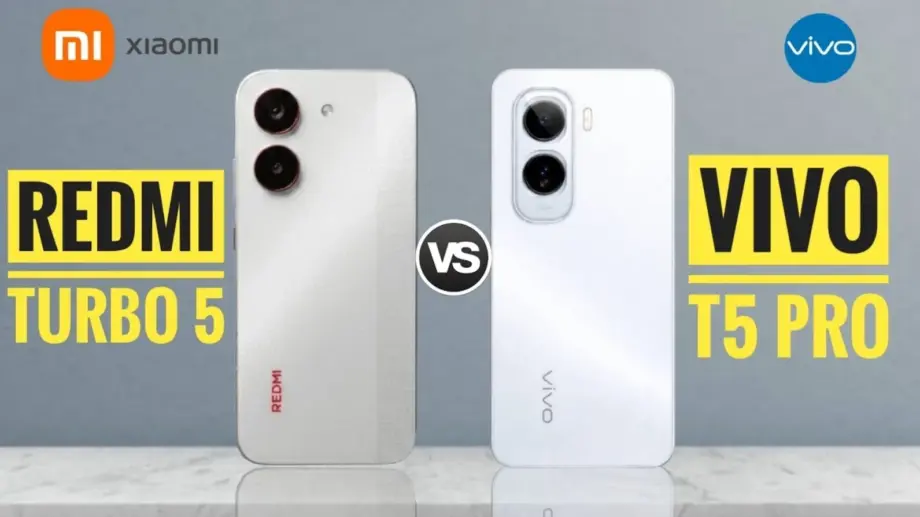
The sub-Rs 40,000 smartphone segment has become one of the most competitive categories in India, with brands focusing on delivering flagship-inspired features at more affordable prices. Xiaomi’s Redmi Turbo 5 and Vivo T5 Pro are two strong contenders that approach the market from different directions.
While the Redmi Turbo 5 is built around performance, gaming, and durability, the Vivo T5 Pro focuses on battery endurance and immersive entertainment. Both devices bring premium specifications, but choosing the right one depends on what matters most to you.
Here’s a complete comparison of the Redmi Turbo 5 and Vivo T5 Pro.
Redmi Turbo 5 vs Vivo T5 Pro: Price in India
The Redmi Turbo 5 enters the market at a slightly higher price point but offers flagship-grade memory and storage technologies.
| Variant | Redmi Turbo 5 | Vivo T5 Pro |
|---|---|---|
| 8GB + 128GB | Not Available | Rs 32,999 |
| 8GB + 256GB | Rs 37,999 (Introductory Price Rs 35,999) | Rs 36,999 |
| 12GB + 256GB | Rs 40,999 | Not Available |
For budget-conscious buyers, Vivo provides a lower entry price. However, Redmi offers a more powerful hardware package for users willing to spend slightly more.
Display and Design: Vivo Focuses on Immersion
Both smartphones feature premium AMOLED displays with 1.5K resolution, but their design philosophies are different.
Redmi Turbo 5
- 6.59-inch AMOLED display
- 120Hz refresh rate
- Peak brightness up to 3,500 nits
- Flat display design
- Aerospace-grade aluminum frame
- Gorilla Glass 7i protection
- Glass back panel
- Customizable Pixel Matrix lighting system
Vivo T5 Pro
- 6.83-inch Curved AMOLED display
- 144Hz refresh rate
- Peak brightness up to 5,000 nits
- Slim curved design
- Glacier Blue and Cosmic Black color options
The Vivo T5 Pro wins on paper with its larger display, faster refresh rate, and significantly higher brightness levels. Users who consume a lot of videos, play games, or prefer curved screens may find Vivo more appealing.
Meanwhile, Redmi’s flat-panel approach offers better usability for gamers and users who dislike accidental touches on curved screens.
Performance: Redmi Turbo 5 Takes a Clear Lead
Performance is where Xiaomi’s offering gains a substantial advantage.
Redmi Turbo 5 Specifications
- MediaTek Dimensity 8500-Ultra
- LPDDR5X RAM
- UFS 4.1 Storage
- Advanced 3D Ice Loop Cooling
Vivo T5 Pro Specifications
- Snapdragon 7s Gen 4
- LPDDR4X RAM
- UFS 3.1 Storage
The Dimensity 8500-Ultra delivers significantly stronger CPU and GPU performance compared to the Snapdragon 7s Gen 4. Combined with faster RAM and storage technologies, the Redmi Turbo 5 provides smoother gaming, quicker app launches, and improved multitasking.
For users who play demanding titles such as BGMI, Call of Duty Mobile, Genshin Impact, or future AAA mobile games, Redmi is the stronger option.
Performance Winner:
Redmi Turbo 5
Battery Life and Charging: Vivo’s Massive Battery Stands Out
Battery capacity is one of the Vivo T5 Pro’s biggest selling points.
Redmi Turbo 5
- 7,540mAh battery
- 100W fast charging
- 27W reverse wired charging
Vivo T5 Pro
- 9,020mAh silicon-anode battery
- 90W fast charging
The Vivo T5 Pro houses one of the largest batteries available in its category. Heavy users can expect significantly longer screen-on time and fewer charging sessions.
Although Redmi charges faster and includes reverse charging support, Vivo delivers superior endurance.
Battery Winner:
Vivo T5 Pro
Camera Comparison
Both devices feature the same primary camera sensor.
Redmi Turbo 5
- 50MP Sony IMX882 primary camera with OIS
- 8MP ultra-wide camera
- 20MP front camera
Vivo T5 Pro
- 50MP Sony IMX882 primary camera with OIS
- 2MP secondary sensor
- 32MP front camera
Since both use the same main sensor, primary camera quality should remain relatively close.
However, Redmi gains an advantage with its usable ultra-wide camera, offering greater shooting flexibility.
Vivo counters with a higher-resolution 32MP selfie camera that may appeal to content creators and social media users.
Rear Camera Winner:
Redmi Turbo 5
Selfie Camera Winner:
Vivo T5 Pro
Software Experience
Redmi Turbo 5
- Android 16
- HyperOS 3
- 4 years Android updates
- 6 years security updates
Vivo T5 Pro
- Android 16
- Funtouch OS
HyperOS 3 provides deeper customization options, productivity features, and better ecosystem integration.
Redmi also benefits from a clearly defined long-term software support policy, making it a stronger choice for buyers planning to keep their device for several years.
Software Winner:
Redmi Turbo 5
Connectivity and Extra Features
The Redmi Turbo 5 includes several premium features often found on flagship devices:
- Wi-Fi 7
- Bluetooth 6.0
- NFC
- Dolby Atmos Stereo Speakers
- IP66, IP68, IP69, and IP69K ratings
The Vivo T5 Pro offers:
- IP68 and IP69 ratings
- Stereo speakers
For connectivity and durability, Redmi provides a more complete package.
Redmi Turbo 5 vs Vivo T5 Pro: Final Verdict
Both smartphones target different audiences, making the choice relatively straightforward.
Buy the Redmi Turbo 5 if you want:
✔ Faster performance
✔ Better gaming experience
✔ Superior RAM and storage technology
✔ Ultra-wide camera support
✔ Longer software support
✔ Advanced connectivity features
✔ Better durability certifications
Buy the Vivo T5 Pro if you want:
✔ Exceptional battery life
✔ Larger curved AMOLED display
✔ Higher brightness levels
✔ Smoother 144Hz refresh rate
✔ Better selfie camera
✔ Lower starting price
Which Phone Offers Better Overall Value?
For most buyers under Rs 40,000, the Redmi Turbo 5 emerges as the better overall value smartphone thanks to its significantly stronger chipset, flagship-grade storage technology, richer feature set, superior durability, and long-term software support.
However, if battery life is your top priority and you prefer a large curved display for entertainment, the Vivo T5 Pro remains one of the strongest battery-focused smartphones available in 2026.
Tech Bext Rating:
- Redmi Turbo 5: 9/10 ⭐
- Vivo T5 Pro: 8.6/10 ⭐
The Redmi Turbo 5 offers the more balanced and future-ready package, while the Vivo T5 Pro excels as an endurance champion for power users.