


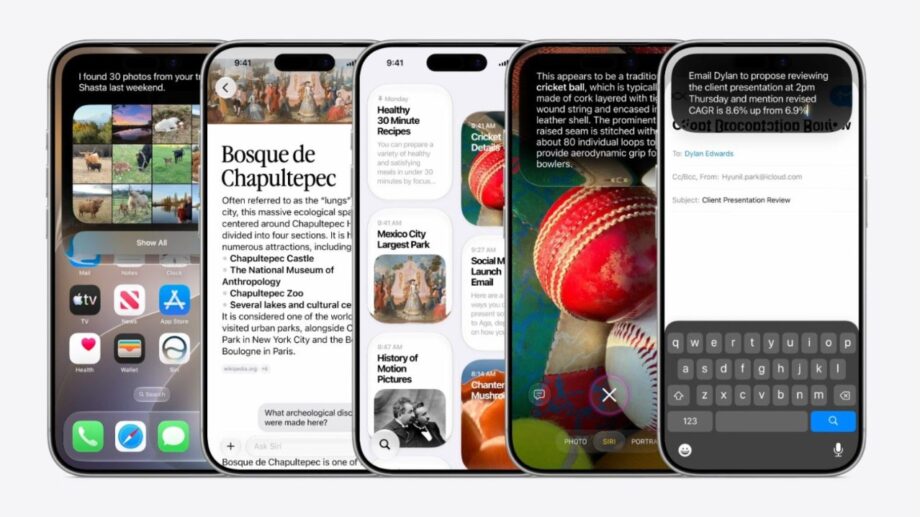
Apple is reportedly working to transform Siri into a more autonomous AI assistant capable of completing tasks on behalf of users. At the same time, the company is said to be revising its iOS 28 and iPadOS 28 development process, giving engineers six weeks for coding and experimentation during the first development milestone, instead of the previous four weeks.
Apple is reportedly preparing another significant upgrade for Siri as it seeks to expand the AI assistant beyond conventional voice commands and basic application interactions.
According to Bloomberg journalist Mark Gurman’s latest Power On newsletter, published on November 8, 2026, Apple is exploring ways to turn Siri into a more autonomous AI agent.
The proposed approach could allow users to delegate tasks to Siri rather than manually carrying out every individual step.
The development follows Apple’s introduction of its revamped AI-powered Siri at the Worldwide Developers Conference (WWDC) in June 2026 and its subsequent rollout through iOS 27.
The report also claims Apple is making changes to the engineering process behind its next major operating system updates.
For iOS 28 and iPadOS 28, the company has reportedly expanded the initial coding and development period from four weeks to six weeks within an eight-week milestone.
The final two weeks would focus on convergence, integration and preparing the software for the next stage.
However, Bloomberg’s reported details concern the first development milestone, known as M1. They do not establish that the same change has been introduced for the later M2 and M3 stages.
Apple has not publicly confirmed the internal schedule changes or announced a release date for the proposed autonomous Siri capabilities.
Apple Wants Siri to Become a More Autonomous AI Agent
The biggest development concerns Apple’s reported plans to give Siri more independent task-execution capabilities.
According to Gurman, Apple wants the assistant to operate more like an autonomous AI agent.
Traditional voice assistants generally respond to specific requests, such as setting alarms, opening applications or retrieving information.
An agentic AI system can potentially go further by carrying out several connected steps toward a broader user-defined goal.
For example, a user might ask an assistant to organise information from different applications, prepare a summary and help complete follow-up actions.
Instead of requiring separate instructions for every step, the assistant could potentially manage parts of the workflow itself.
However, the Bloomberg report does not establish the precise tasks, permissions or application integrations Apple intends to support.
It also does not confirm that Siri will be allowed to execute every action without user approval.
What Could Autonomous Siri AI Actually Do?
The proposed upgrade could change the way people interact with their iPhones, iPads and Macs.
Today, Siri can help with various tasks, including composing messages, creating reminders and interacting with supported application functions.
According to the supplied report, Apple has also introduced additional in-app capabilities through its iOS 27.3 beta software.
The next stage could involve giving users greater freedom to delegate longer workflows.
Potential examples of agentic assistance include organising information, preparing documents, coordinating tasks and responding to changes in connected services.
However, these examples illustrate what autonomous assistants can do generally. They are not confirmed features of Apple’s forthcoming Siri update.
The important distinction is between an assistant that performs a single command and one that can plan or coordinate multiple steps.
Apple’s reported objective is to move Siri closer to the latter model.
Siri AI Could Compete More Directly With OpenAI Dots, Meta Muse and Grok
The Bloomberg report reportedly compares Apple’s ambitions with increasingly agentic AI products and assistants.
These include OpenAI’s Dots, Meta’s Muse and Grok.
The broader direction of the AI industry involves systems that do more than answer questions.
Some AI products can work across connected applications, carry out delegated tasks and monitor selected information sources for relevant changes.
Others focus on conversational assistance, multimodal interaction or particular productivity functions.
However, these products do not necessarily offer identical capabilities, and their availability, permissions and levels of autonomy differ.
The supplied report does not confirm that Apple plans to reproduce any particular competitor’s complete feature set.
Instead, the comparison highlights Apple’s ambition to make Siri more capable of taking action.
Why Agentic Siri Would Be Different From Today’s Assistant
The difference between conventional and agentic AI can be understood through the number of steps involved in a task.
A conventional assistant might create a calendar event after receiving a direct instruction.
An agentic assistant could potentially interpret a broader objective, gather relevant details, coordinate supported applications and prepare a proposed action.
Such capabilities could be especially useful for people who regularly manage email, calendars, reminders and other productivity tools.
However, autonomous actions also introduce important reliability and privacy considerations.
Users need to understand what information an assistant can access, which operations it may perform and when approval is required.
An assistant that can modify information or communicate with other people must also handle errors carefully.
Apple has not disclosed how it intends to manage these questions in the proposed Siri upgrade.
Apple Reportedly Released More Advanced Siri In-App Actions in iOS 27.3 Beta
The supplied report also states that Apple recently introduced an iOS 27.3 beta containing more advanced in-app actions for Siri.
These capabilities reportedly expand what the assistant can do inside supported applications.
However, the exact scope of those beta features is not established by the provided information.
A feature appearing in beta software does not necessarily guarantee that it will be included unchanged in the next public release.
Availability may also depend on the device, language, region and individual application.
The broader Siri upgrade described by Bloomberg would represent a further step beyond these existing application interactions.
Will Autonomous Siri AI Launch in 2027?
According to Gurman’s report, Apple could introduce expanded agentic Siri capabilities as soon as 2027.
That timing remains provisional.
The report does not provide a confirmed launch date or establish that the features will debut specifically with iOS 28.
Apple could introduce some capabilities through intermediate software updates while reserving others for a later release.
It is also possible that the planned functionality will change during development.
For now, users should not assume that every proposed feature will become available at the same time.
Apple Changes Its iOS 28 Development Strategy
Alongside the Siri development, Apple is reportedly adjusting how engineers build the next versions of iOS and iPadOS.
According to Bloomberg, the company’s operating system development process is divided into three major stages:
- M1
- M2
- M3
Each stage reportedly spans eight weeks.
The previous structure for the first milestone included four weeks of coding, exploration and feature development, followed by four weeks of convergence.
Convergence is the period when engineers focus on combining work, resolving integration problems and stabilising the software.
For iOS 28, Apple has reportedly changed the M1 structure to allow more time for initial development.
Engineers would spend six weeks coding and exploring features, followed by two weeks of convergence.
iOS 28 M1 Development Schedule: Old vs New
| Development activity | Previous M1 schedule | Reported iOS 28 M1 schedule |
|---|---|---|
| Coding and feature exploration | 4 weeks | 6 weeks |
| Convergence and integration | 4 weeks | 2 weeks |
| Total milestone duration | 8 weeks | 8 weeks |
| Share devoted to coding | 50% | 75% |
| Share devoted to convergence | 50% | 25% |
The change adds two weeks to the initial development period without changing the overall length of M1.
It does not necessarily mean Apple is shortening the entire iOS 28 development cycle.
What Does the Six-Week Coding Period Mean for iOS 28?
Under the reported arrangement, Apple engineers would receive more time to develop and experiment with features during the first milestone.
The amount of time allocated to coding would increase by 50%, from four weeks to six weeks.
Meanwhile, the convergence period would be reduced by 50%, from four weeks to two weeks.
This could give teams more flexibility during the early development stage.
However, reducing the convergence window could also place greater demands on integration and testing processes.
Whether the new schedule improves productivity or software quality will depend on how Apple manages the transition.
The supplied information does not include internal performance data or evidence that the revised process has already produced better results.
Are Apple’s M2 and M3 Milestones Changing Too?
The supplied report identifies a specific change to the M1 development stage.
Although Apple’s overall process reportedly includes M1, M2 and M3, it does not confirm equivalent changes to the later milestones.
Therefore, it would be inaccurate to claim that all three stages now use six weeks of development and two weeks of convergence.
The revised structure should be described as an M1 change unless further reliable information establishes a broader overhaul.
Reported iOS 28 Development Milestones
| Milestone | Reported duration | Confirmed change in supplied report |
|---|---|---|
| M1 | 8 weeks | 6 weeks coding, 2 weeks convergence |
| M2 | 8 weeks | No specific schedule change confirmed |
| M3 | 8 weeks | No specific schedule change confirmed |
This distinction matters because the engineering impact would be different if the changes applied to one stage rather than the entire development schedule.
Why Apple Might Be Giving Engineers More Development Time
Apple reportedly wants engineers to have additional time for coding, exploration and feature development.
Complex operating system features often require coordination across multiple teams.
An AI capability, for example, may involve changes to system interfaces, application permissions, local processing and cloud services.
However, the supplied reporting does not explicitly establish that the M1 schedule change was made specifically to support autonomous Siri.
The two developments may be related to Apple’s broader software priorities, but a direct causal connection has not been demonstrated.
It is more accurate to say that Apple is reportedly pursuing agentic Siri features while also changing part of its software engineering process.
What We Know About iOS 28 and iPadOS 28
The next major versions of Apple’s mobile operating systems are expected to continue development through 2027.
The supplied report identifies iOS 28 and iPadOS 28 as the software projects affected by the revised engineering approach.
However, Apple has not announced a complete public feature list or confirmed the final release schedule.
Previous reporting has suggested that beta versions could appear around WWDC 2027, with public releases potentially following later in the year.
Those dates should be treated as expectations based on Apple’s usual release patterns rather than confirmed announcements.
The report also does not establish whether the new Siri capabilities will be available on every device compatible with iOS 28.
What About macOS 28?
Previous reporting has also referenced Apple’s development work on macOS 28, reportedly codenamed Poppy.
However, the specific six-week coding and two-week convergence change described in the latest material is tied to the first milestone of iOS 28 and iPadOS 28.
The supplied source does not confirm that macOS 28 follows the same revised structure.
Likewise, a shared development year does not guarantee that Apple will introduce identical agentic Siri features across all its operating systems simultaneously.
What Could the Siri Upgrade Mean for iPhone, iPad and Mac Users?
A more autonomous Siri could potentially reduce the amount of manual work required for repetitive tasks.
Users might eventually be able to delegate supported activities involving multiple applications.
However, practical usefulness would depend on the accuracy of the assistant, available integrations and permission controls.
An agentic assistant also needs to distinguish between tasks it can safely complete automatically and those that require explicit approval.
Examples include sending messages, changing calendar information, managing files or interacting with accounts.
Apple has not confirmed the approval model, data-handling practices or supported third-party services for the rumoured upgrade.
Consequently, the real-world experience cannot yet be assessed.
Agentic Siri AI: Reported vs Confirmed Details
| Feature or development | Status |
|---|---|
| Siri assisting with messages and reminders | Existing functionality described in source |
| Advanced in-app actions in iOS 27.3 beta | Reported beta functionality |
| Broader autonomous task execution | Under development, according to report |
| Background task monitoring | Not confirmed specifically for Siri |
| Third-party app integrations | Scope not confirmed |
| Rollout during 2027 | Reported possibility |
| Launch with iOS 28 | Not confirmed |
| New M1 coding period | 6 weeks, reportedly |
| New M1 convergence period | 2 weeks, reportedly |
| Equivalent M2 and M3 changes | Not established |
What Happens Next?
Apple is reportedly working on two important software initiatives.
The first involves expanding Siri’s capabilities so it can take on more complex, multi-step tasks.
The second concerns changes to the development process for iOS 28 and iPadOS 28.
According to Bloomberg, engineers will receive more time for coding and exploration during the first eight-week milestone, with the convergence period reduced accordingly.
However, Apple has not announced the new autonomous Siri functions or confirmed their public availability.
The M1 development changes are also based on reporting rather than an official engineering disclosure.
The central development is Apple’s reported plan to turn Siri into a more autonomous AI agent while extending the iOS 28 M1 coding period from four weeks to six weeks.
The effectiveness of the strategy will depend on the final feature set, implementation and software quality.
TechLayers will continue following Apple’s AI developments, upcoming software releases and changes to the iPhone ecosystem.
Have a story tip or feedback? Contact [email protected].
© TechLayers. Original editorial content.