


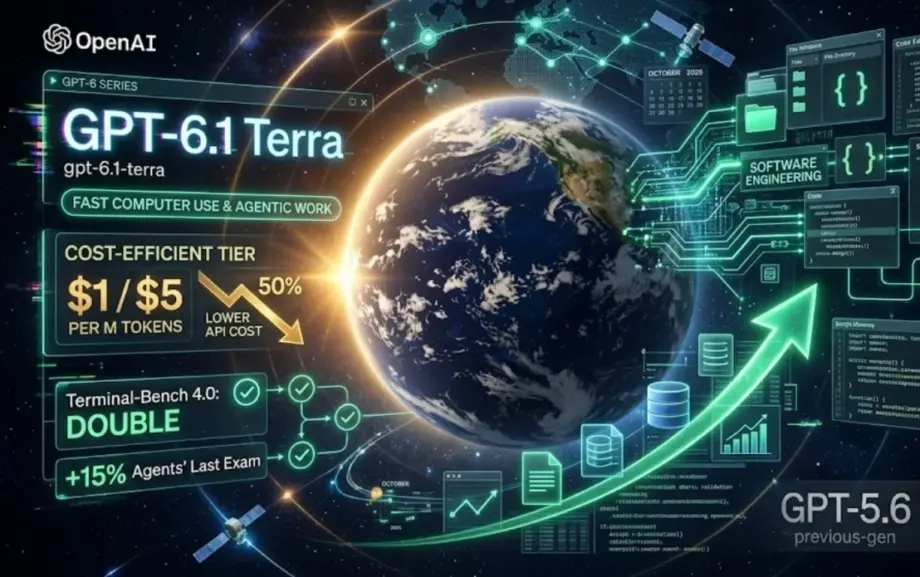
The model is available in ChatGPT Work, Codex and the API, with OpenAI reporting gains over GPT-5.6 Terra in selected evaluations.
OpenAI has introduced GPT-6.1 Terra, a model focused on visual reasoning, computer-based tasks, writing and software engineering.
It succeeds GPT-5.6 Terra and joins GPT-6.1 Sol in the company’s GPT-6.1 lineup. OpenAI says the new model improves performance on tasks such as interpreting technical drawings, drafting proposals, completing forms and working with desktop applications.
The launch also brings lower standard API prices. However, the benchmark comparisons remain OpenAI-reported results rather than independent findings from TechLayers.
GPT-6.1 Terra Availability
OpenAI says GPT-6.1 Terra is available to Plus, Pro, Enterprise and Edu subscribers through ChatGPT Work and Codex.
Developers can access the model through the OpenAI API using the identifier gpt-6.1-terra.
Subscription access and API usage are separate routes. The API prices below describe developer usage; they should not be presented as the price of a ChatGPT subscription.
Standard API Pricing
| Token category | Price per million tokens |
|---|---|
| Input | $1 |
| Cached input | $0.05 |
| Output | $5 |
OpenAI describes the standard rates as 50 percent lower than those of GPT-5.6 Terra and GPT-6.1 Sol.
Cached-input pricing applies to eligible cached tokens, not automatically to every request. Developers should also check processing modes, context-length adjustments and applicable tool charges when estimating costs.
For a simplified example, one million uncached input tokens and 100,000 output tokens would cost $1.50 at the listed standard rates, before other applicable charges or adjustments.
Actual task costs depend on how many tokens the workflow consumes, whether it retries and which tools it uses.
Computer-Use Improvements
OpenAI reports stronger results on evaluations involving visual understanding and actions inside software.
These tasks differ from answering a question in chat. An agent may need to interpret a screen, choose a control, enter information and check whether the action produced the intended result.
The company’s examples include technical-drawing interpretation, form completion and creative workflows.
Successful completion still depends on the surrounding tools, permissions and application environment. A model capability claim does not mean it can access every program or complete every workflow automatically.
How to Read the Benchmark Comparisons
The launch material compares models at different reasoning settings and price levels.
Those details matter because reasoning effort can affect latency, token consumption and results. A comparison at maximum effort should not be treated as interchangeable with one at a lower setting.
Likewise, outperforming another model on a particular benchmark does not establish superiority across all work.
Buyers and developers should examine which tasks an evaluation measures and whether those tasks resemble their own workloads.
Software Engineering Gains
OpenAI says GPT-6.1 Terra improves on GPT-5.6 Terra in software engineering.
Coding-agent evaluations can test command-line problem solving, repository changes and other development tasks. They provide useful evidence, but they do not replace testing on a team’s own codebase.
A model that handles routine changes efficiently may still need additional review for complex architecture, unfamiliar dependencies or difficult debugging.
For practical evaluation, teams can compare successful task completion, test results, review effort, elapsed time and total cost together.
Factuality and Prompt-Injection Resistance
OpenAI also reports reduced factual errors and improved resistance to malicious instructions designed to divert the model from its assigned task.
These are improvements claimed under specific test conditions. They should not be described as eliminating hallucinations or making prompt injection impossible.
External documents, websites and repositories can contain misleading instructions. Workflows involving those sources still benefit from clear permissions, verification and review before consequential actions.
What the Pricing Change Means
Lower rates can make repeated document-processing, coding and computer-use tasks less expensive to run.
The more useful measure, however, is cost per successfully completed task. A low-priced request that requires several retries or extensive correction may offer less value than its token rate suggests.
Developers considering GPT-6.1 Terra should therefore evaluate it on representative tasks with known acceptance criteria.
The launch establishes another option for balancing capability, speed and spending. Its practical value will depend on the work being done and the reliability required.