

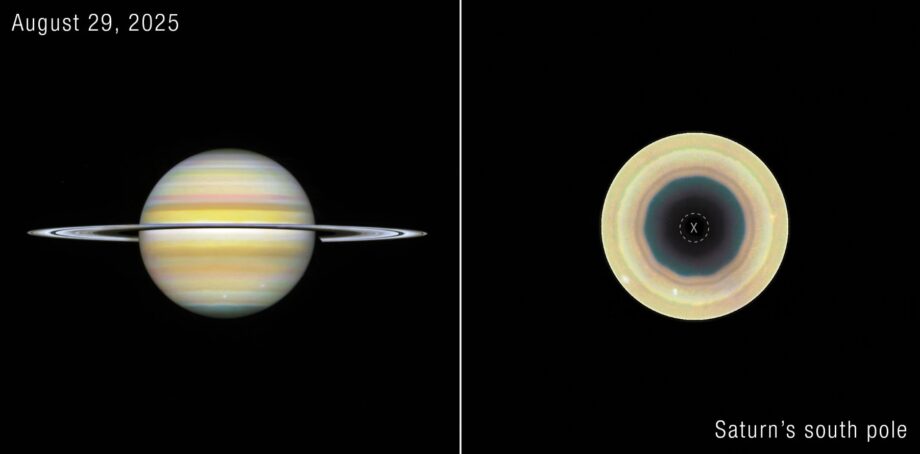
Saturn’s weather has produced another remarkable geometric pattern. Astronomers using NASA’s Hubble Space Telescope have identified a large, ten-sided atmospheric wave surrounding the planet’s south pole, adding a surprising new chapter to the story of Saturn’s famous polar weather.
The feature, described as a decagon, stretches roughly 104,000 miles (about 168,000 kilometres) across and sits around 63 degrees south latitude.
Rather than being a solid or permanent marking on Saturn, the structure is an atmospheric wave embedded in a powerful circumpolar jet. Its discovery is particularly significant because Saturn’s northern hemisphere is already famous for another unusual atmospheric pattern: the six-sided jet stream known as the Saturn hexagon.
The new southern feature is not identical to the northern hexagon. Instead, researchers are interested in what the two structures may reveal about how powerful planetary jet streams can organise themselves into stable, large-scale patterns.
Hubble Reveals Saturn’s Southern Decagon
The newly identified feature became visible as Saturn’s south pole gradually returned to a favourable viewing position from Earth.
Researchers analysed observations from Hubble’s Outer Planet Atmospheres Legacy (OPAL) programme, which repeatedly observes the outer planets using consistent observing techniques.
The long-term nature of the OPAL dataset was crucial.
Rather than relying on a single image, scientists could compare observations obtained over multiple years and follow changes in the atmospheric structure.
The decagon was already faintly visible in Hubble observations from 2023 and became more pronounced in subsequent observations.
Ground-based observations made by amateur astronomers also helped draw attention to unusual structure around Saturn’s southern polar region during 2024 and 2025.
That combination of observations gave researchers an opportunity to investigate the feature in greater detail.
A Pattern More Than 100,000 Miles Wide
The scale of Saturn’s southern atmospheric pattern is difficult to comprehend.
The structure measures approximately 104,250 miles (167,820 kilometres) across, according to measurements reported in coverage of the research.
Each of its apparent sides is roughly 10,425 miles (16,782 kilometres) long.
Those dimensions should not be interpreted as the measurements of a rigid polygon. The decagon is a pattern created by moving gases and atmospheric waves, so its edges and apparent corners can change over time.
The important point is its enormous scale.
The atmospheric structure is comparable to many times the diameter of Earth and occupies a substantial region around Saturn’s southern polar atmosphere.
It Is Not a Giant Solid Storm
Calling the feature a “ten-sided storm” makes for a striking description, but its physical nature is more subtle.
The decagon is an atmospheric wave associated with a powerful jet stream.
Saturn is a gas giant with no solid surface like Earth. Its visible atmosphere contains enormous systems of clouds, winds and waves that can extend over vast distances.
In this case, researchers found evidence that the feature is present through more than one atmospheric layer.
Observations made using different wavelengths can probe different levels of Saturn’s atmosphere. The apparent movement of the structure between filters provides information about how the atmospheric pattern changes with altitude.
That makes the discovery more interesting than simply finding a strange shape in a photograph.
Scientists are studying a three-dimensional atmospheric phenomenon.
Saturn Already Has a Famous Hexagon
The discovery immediately brings Saturn’s northern hexagon to mind.
NASA’s Voyager spacecraft first revealed the extraordinary six-sided pattern around Saturn’s north pole more than four decades ago.
Later observations, particularly from the Cassini mission, showed that the hexagonal jet is a deep and persistent atmospheric feature rather than a temporary cloud formation.
The northern hexagon has survived for decades while Saturn’s atmosphere changed with the seasons.
Its extraordinary longevity has made it one of the most recognisable weather phenomena in the Solar System.
The newly observed southern decagon raises a natural question:
Could Saturn’s atmosphere be capable of producing multiple long-lived polygonal jet patterns?
Researchers are not yet claiming that the two structures have the same origin or will behave in the same way.
But the comparison provides an important opportunity to investigate the physics of planetary atmospheres.
Why Does Saturn Make Geometric Jet Streams?
The apparent geometry of Saturn’s polar jets is not thought to result from a hidden physical boundary drawing a shape into the clouds.
Instead, scientists study these patterns as products of fluid dynamics and atmospheric instabilities.
When a rapidly rotating atmosphere contains strong jet streams, waves can develop within the flow.
Under particular combinations of wind speed, atmospheric depth, rotation and shear, those waves can organise into large-scale patterns.
Laboratory experiments using rotating fluids have produced polygon-like structures under certain conditions.
Saturn therefore provides a natural laboratory on a vastly larger scale.
The challenge is determining which combination of atmospheric conditions produces the specific structures observed on the planet.
Six Sides in the North, Ten in the South
One of the most intriguing aspects of the discovery is that the southern pattern has ten apparent sides, while the famous northern jet has six.
That difference is scientifically meaningful.
The number of lobes or sides in an atmospheric wave can be related to properties of the underlying jet, including its width, velocity and the amount of wind shear within the flow.
Consequently, the southern decagon suggests that Saturn’s southern polar jet is dynamically different from its northern counterpart.
The discovery does not mean Saturn has simply copied its northern weather system in the opposite hemisphere.
Instead, the two polar patterns may offer researchers a natural comparison between different atmospheric conditions on the same planet.
Why Was the Decagon Not Seen Earlier?
The timing of the discovery is another major question.
Saturn takes roughly 29.5 Earth years to orbit the Sun, and its substantial axial tilt means that its poles experience dramatic seasonal changes.
Earth-based observers also cannot continuously monitor both poles under equally favourable viewing conditions.
Saturn’s south pole was not in an ideal position for detailed long-term observations from Earth for many years.
The Cassini spacecraft provided extensive observations of Saturn between 2004 and 2017, including important observations of the southern polar region.
Cassini detected a warm polar vortex and a prominent cyclone at Saturn’s south pole, but researchers did not identify a long-lived southern polygon corresponding to the northern hexagon in the available observations.
That raises the possibility that the newly observed decagon developed or became organised relatively recently, rather than simply remaining hidden for decades.
More observations will be required to establish its history.
Hubble’s Long-Term Monitoring Proves Valuable
The discovery demonstrates why repeated observations can be as important as spectacular one-time images.
The OPAL programme, led by NASA astronomer Amy Simon, has been monitoring Jupiter, Saturn, Uranus and Neptune over many years.
Using comparable observations from different years allows scientists to distinguish genuine atmospheric changes from differences caused by observing conditions or instruments.
In Saturn’s case, the long-term record made it possible to track the southern feature as it became increasingly apparent.
The work was led by Agustín Sánchez-Lavega of the University of the Basque Country in Bilbao, Spain, with researchers including Amy Simon of NASA’s Goddard Space Flight Center and Mike Wong of the University of California, Berkeley.
The findings were reported in research published in Science Advances in September 2026.
Could Saturn’s Decagon Last for Decades?
That remains unknown.
The northern hexagon has persisted for more than 40 years, making it one of the longest-lived atmospheric structures ever observed beyond Earth.
Whether the southern decagon will have a similar lifespan is an open scientific question.
Researchers will want to know whether its sides become sharper or less defined, whether the pattern changes its shape, whether it moves in longitude and whether the number of apparent lobes remains stable.
It is also possible that the structure could weaken or disappear.
Continued monitoring will therefore be essential.
What Could Hubble and Webb Reveal Next?
Future observations could help scientists determine how deep the decagonal pattern extends into Saturn’s atmosphere and how its temperature structure changes with altitude.
Hubble’s continued optical observations can provide a valuable long-term record of the visible atmospheric pattern.
The James Webb Space Telescope, operating primarily at infrared wavelengths, offers a complementary capability by observing thermal and atmospheric properties that cannot be studied in exactly the same way using visible-light observations.
Combining observations from different instruments with computer simulations could help researchers test whether current models of Saturn’s atmospheric dynamics can reproduce both the northern hexagon and southern decagon.
A New Test for Planetary Weather Models
The discovery matters beyond Saturn itself.
Planetary scientists use giant planets as natural laboratories for studying fluid dynamics under conditions impossible to reproduce fully on Earth.
Saturn’s rapid rotation, deep atmosphere and powerful jet streams create an environment in which enormous waves and vortices can persist for years or decades.
Understanding why those structures form could improve scientists’ broader understanding of atmospheric circulation on gas giants and potentially other planets.
The decagon therefore represents more than an unusual image.
It is another piece of evidence that planetary atmospheres can organise chaotic-looking flows into remarkably ordered structures.
Saturn’s South Pole Has More Secrets to Reveal
For now, the most important fact is also the simplest: Saturn has a huge ten-sided atmospheric wave around its south pole, and scientists are watching to see what it does next.
The feature is roughly 104,000 miles wide and appears to be embedded in a strong circumpolar jet.
Its existence provides a striking comparison with Saturn’s northern hexagon, but scientists still need more observations and modelling to determine exactly how the southern pattern formed and whether it will persist.
If the decagon continues to strengthen or survives for decades, it could become one of the most important long-term atmospheric phenomena discovered on Saturn since the northern hexagon itself.
For a planet already famous for its rings, Saturn has once again demonstrated that some of its most fascinating features are hidden not in its solid-looking appearance, but in the enormous and constantly moving atmosphere above its clouds.