

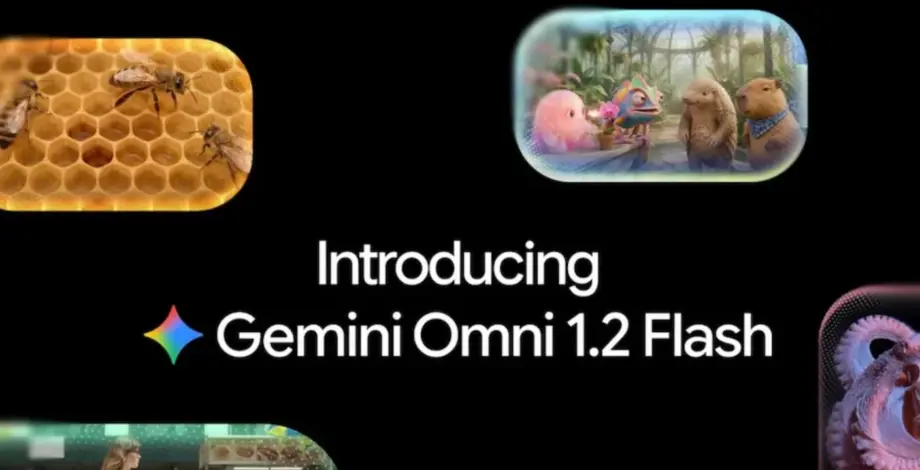
Google DeepMind has introduced Gemini Omni 1.2 Flash, an AI video generation model that supports clips up to 15 seconds long, conversational editing and enhanced audio generation. The company says the model costs 30 percent less than its predecessor, with video generation priced from $0.07 per second.
Google DeepMind has announced Gemini Omni 1.2 Flash, a new artificial intelligence model designed to make video creation faster, more flexible and affordable for developers, businesses and content creators.
The latest model supports generating and editing continuous video clips lasting up to 15 seconds, an increase from the 10-second limit reported for Gemini Omni 1.1. It also introduces conversational editing capabilities, allowing users to modify existing AI-generated footage through follow-up instructions instead of starting the generation process again.
According to Google, Gemini Omni 1.2 Flash offers a 30 percent reduction in video generation pricing compared with its predecessor. The company lists a starting rate of $0.07 per second for 360p and 720p output, making the model particularly relevant to creators who need to experiment with multiple versions of short videos.
The model is being introduced through Google AI Studio and the Gemini API, with enterprise access also available through Google Cloud.
Beyond longer clips and lower costs, Google is highlighting improvements in character consistency, camera control, dialogue generation and lip synchronisation.
Google Gemini Omni 1.2 Flash: What’s New?
Google announced Gemini Omni 1.2 Flash in a blog post published in November 2026, outlining several improvements intended to simplify AI-powered video production.
One of the biggest changes is support for native video generation lasting up to 15 seconds.
Users can specify a duration between three and 15 seconds in one-second increments, giving them more control over the length of individual clips.
This makes the model suitable for short promotional videos, social media content, product demonstrations and creative experiments that require precise timing.
Another major addition is conversational editing, which allows creators to refine an existing clip using natural-language instructions.
Instead of regenerating a video whenever a detail needs to change, users can request adjustments to elements such as the background, lighting, weather or aspect ratio.
Google says the model is designed to maintain greater visual consistency while making these modifications.
However, the quality and reliability of those changes will depend on the complexity of the scene, the instructions provided and the model’s actual performance.
Gemini Omni 1.2 Flash Supports AI Video Clips Up to 15 Seconds
The extended generation duration is a central feature of the new model.
Gemini Omni 1.1 reportedly supported video clips lasting up to 10 seconds, while Gemini Omni 1.2 Flash increases the maximum duration to 15 seconds.
Although the difference may appear relatively small, five additional seconds can provide more room for establishing a scene, introducing movement or completing a short visual sequence.
For example, a creator developing a product advertisement may need time to show the product from multiple angles before displaying a final close-up.
A longer clip can potentially accommodate more of that sequence in one continuous generation.
The model also allows users to select exact durations within its supported range, helping creators produce videos suited to specific formats.
Gemini Omni 1.1 vs Gemini Omni 1.2 Flash
| Feature | Gemini Omni 1.1 | Gemini Omni 1.2 Flash |
|---|---|---|
| Maximum reported clip length | 10 seconds | 15 seconds |
| Minimum selectable duration | Not established here | 3 seconds |
| Duration increments | Not established here | 1 second |
| Video generation pricing | Higher baseline | Reportedly 30% lower |
| 720p generation cost | Not specified | $0.07 per second |
| Conversational editing | Not established here | Supported |
| Audio improvements | Previous generation | Improved dialogue and lip-sync claimed |
| Frame consistency | Previous generation | Enhanced consistency claimed |
The comparison uses the announcement information provided. It is not an independently benchmarked evaluation of either model.
The extended duration could help creators produce more complete short-form scenes without relying on as many separately generated segments.
However, Google has not established in the supplied material that every complex scene will remain visually consistent throughout the full 15-second duration.
Gemini Omni 1.2 Flash Pricing Starts at $0.07 Per Second
Pricing is another significant change in Google’s latest AI video model.
According to the company, Gemini Omni 1.2 Flash costs $0.07 per second for video generation at 360p or 720p.
Google describes this as a 30 percent reduction compared with Gemini Omni 1.1.
For developers experimenting with multiple generations, a lower per-second rate could help reduce the cost of prototyping video content.
Estimated Video Generation Cost
| Generated duration | Cost at $0.07 per second |
|---|---|
| 3 seconds | $0.21 |
| 5 seconds | $0.35 |
| 8 seconds | $0.56 |
| 10 seconds | $0.70 |
| 12 seconds | $0.84 |
| 15 seconds | $1.05 |
These are illustrative generation charges calculated from the reported $0.07-per-second rate. They exclude taxes, upscaling charges and any other applicable service fees.
The model also supports a workflow in which users generate an initial draft at 360p or 720p, make subsequent edits and then upscale the result to 1080p or 4K.
However, the supplied announcement does not establish whether higher-resolution upscaling is included in the base generation price.
Businesses planning production workloads should check Google’s official pricing documentation for current charges, usage restrictions and any additional costs.
Conversational Editing Lets Users Modify Videos Without Starting Over
One of the more practical additions to Gemini Omni 1.2 Flash is its support for multi-turn conversational video editing.
Traditionally, AI video generation can require users to recreate an entire clip when a particular detail is incorrect or needs adjustment.
For example, a creator might generate a product advertisement and discover that the background does not match the intended campaign.
With conversational editing, the user can reportedly provide a follow-up instruction asking the model to change the background while retaining the broader scene.
Google says the model supports several types of modifications, including:
- Replacing a product or object in an existing scene.
- Changing the background or environment.
- Adjusting lighting conditions or weather.
- Modifying the video’s aspect ratio.
- Refining existing footage through multiple conversational instructions.
The system is designed to support these editing interactions for clips up to 15 seconds long.
This could be particularly valuable for advertising teams that need to produce several variations of the same creative concept.
For example, a brand could potentially create different promotional versions with alternative backgrounds, lighting conditions or product placements.
However, the ability to request a change does not guarantee that every other visual element will remain identical.
Editing accuracy, consistency and output quality will need to be assessed through practical testing.
Improved Character and Product Consistency Across Frames
Maintaining consistent characters and objects is one of the more challenging aspects of AI video generation.
A generated person may appear to change slightly between frames, while clothing details, product packaging or background elements can shift during camera movements.
Google says Gemini Omni 1.2 Flash introduces improvements intended to reduce these inconsistencies.
The model can reportedly use multiple types of reference information, including character photographs, product images, style references, motion clips and audio cues.
Short reference motion clips of up to three seconds can also be incorporated into the generation process.
These inputs are intended to help creators establish more consistent visual identities across a scene.
Google specifically highlights improved consistency for faces, clothing, product packaging typography and brand colours.
Such capabilities may be useful for commercial video production, where visual accuracy is important.
For instance, a company creating promotional content would generally want its product logo and packaging to remain recognisable as the camera moves.
Nevertheless, brands should manually inspect AI-generated results before publication.
Even advanced generative models can produce incorrect lettering, inconsistent details or visually misleading representations.
Gemini Omni 1.2 Flash Adds More Natural AI Audio and Lip-Sync
Google has also announced improvements to the model’s audio generation capabilities.
Gemini Omni 1.2 Flash is claimed to deliver more natural-sounding dialogue, improved lip synchronisation and better handling of multiple speakers.
Synchronising generated speech with facial movements is important for videos featuring speaking characters.
When mouth movements do not align with dialogue, even visually convincing footage can feel unnatural.
Google says the new model is designed to improve this aspect of AI-generated video.
Multi-speaker conditioning is another notable capability. It is intended to help the model distinguish between different speakers and produce more coherent conversations involving multiple characters.
These improvements could be relevant to scripted advertisements, animated demonstrations, educational content and short fictional scenes.
However, the supplied announcement does not provide independent performance measurements for speech accuracy, lip-sync timing or multilingual dialogue.
Creators should therefore review spoken content carefully, especially when producing material containing technical information, brand messages or factual claims.
Support for Complex Camera Movements
Gemini Omni 1.2 Flash also expands the camera movements users can request during video generation.
According to Google, the model supports effects such as first-person-view-style flythroughs, zoom-outs and orbital camera movements.
These techniques are commonly used in promotional videos and cinematic sequences.
An orbital movement, for example, can show a product from several angles as the camera moves around it.
A zoom-out can gradually reveal a larger environment, while an FPV-style sequence can create the impression of moving through a scene.
AI-generated camera movements may help creators experiment with visual concepts that would otherwise require specialised filming equipment or animation work.
However, generated camera motion should not be confused with physically accurate simulation.
The model may still produce unrealistic geometry, distorted objects or continuity errors, particularly in complex scenes.
Where Can Developers Access Gemini Omni 1.2 Flash?
Google says Gemini Omni 1.2 Flash is being made available through its developer and enterprise platforms.
Developers can access the model through Google AI Studio and the Gemini API.
Businesses using Google’s cloud infrastructure can explore the model through Google Cloud, subject to the applicable service availability and account requirements.
The company has also indicated that the technology is expected to support video creation experiences across Google products and services as the rollout expands.
These include Flow, Google Vids and business-focused Gemini experiences.
However, the presence of a model in a developer platform does not necessarily mean every consumer-facing Google application immediately offers the same capabilities.
Access limits, supported regions, pricing and integration options may differ between services.
Google Gemini Omni 1.2 Flash Availability
| Platform | Reported availability |
|---|---|
| Google AI Studio | Developer access announced |
| Gemini API | Model access announced |
| Google Cloud | Enterprise access announced |
| Google Flow | Capabilities expected through rollout |
| Google Vids | Expected to benefit from model improvements |
| Other Gemini experiences | Availability may expand |
Developers should consult the official documentation to confirm the exact model identifier, supported API operations, quotas and current pricing before integrating it into production applications.
What Could Gemini Omni 1.2 Flash Mean for Content Creators?
The latest announcement highlights several potential benefits for creators producing short-form video content.
The longer generation duration may allow more complete visual sequences, while conversational editing could reduce the need to restart a project after every adjustment.
Reference images and motion clips may also help creators maintain a consistent visual style across multiple versions of a campaign.
For marketing teams, this could make it easier to test alternative creative concepts without producing each variation from scratch.
Small businesses may find the lower reported per-second generation cost appealing for early-stage promotional experiments.
However, production quality still depends on human direction, review and editing.
AI-generated video can introduce inaccuracies involving objects, text, movement or speech.
Creators working with real individuals, trademarks or copyrighted visual material should also ensure they have appropriate rights and permissions.
For commercial use, it is particularly important to check Google’s applicable AI content policies and licensing terms.
Is Gemini Omni 1.2 Flash Available in India?
Google has announced developer and enterprise availability through AI Studio, the Gemini API and Google Cloud.
However, the supplied information does not include an India-specific release announcement or a detailed country-by-country availability list.
Indian developers interested in testing the model should check whether the relevant API and cloud services are supported for their account and region.
The reported $0.07-per-second price is quoted in US dollars, and local billing may be affected by currency conversion, taxes and Google’s payment terms.
Consumers should also distinguish between access through developer tools and access through Google’s consumer-facing applications.
Availability through Google AI Studio does not guarantee that the same features are immediately available inside the standard Gemini app.
Gemini Omni 1.2 Flash Specifications and Features at a Glance
| Feature | Reported details |
|---|---|
| Company | Google DeepMind |
| Model | Gemini Omni 1.2 Flash |
| Model type | AI video generation and editing |
| Announcement | November 2026 |
| Maximum video duration | 15 seconds |
| Minimum video duration | 3 seconds |
| Duration increments | 1 second |
| Draft resolutions | 360p and 720p |
| Higher-resolution output | Upscaling to 1080p or 4K |
| Reported price | $0.07 per second |
| Price reduction | 30% compared with Omni 1.1 |
| Editing | Multi-turn conversational editing |
| Reference inputs | Images, short motion clips, audio cues |
| Reference motion duration | Up to 3 seconds |
| Audio | Dialogue generation, lip-sync, multi-speaker support |
| Camera controls | FPV flythroughs, zoom-outs, orbital shots |
| Developer access | Google AI Studio, Gemini API |
| Enterprise access | Google Cloud |
| India availability | Region-specific details not confirmed here |
How Does Gemini Omni 1.2 Flash Change AI Video Production?
Google’s latest model reflects an effort to make generative video tools more practical for repeated editing and commercial workflows.
The combination of longer clips, lower reported costs and conversational modification addresses several limitations associated with creating AI-generated videos.
Instead of treating each output as a finished product that must be regenerated whenever something changes, users may be able to work more iteratively.
This approach could be especially useful for creating advertisements, social media clips and product demonstrations that require multiple versions.
However, the model’s usefulness will ultimately depend on the reliability of its outputs, editing accuracy and total production cost.
Gemini Omni 1.2 Flash’s most significant advancement may be the combination of native 15-second generation and conversational editing, rather than the longer duration alone.
For developers and businesses, the ability to make targeted changes while retaining an existing visual concept could become an important part of AI-assisted video production.
Google is expected to expand access to its video generation technology through additional products and services as the rollout progresses.
TechLayers will continue following developments in Google’s generative AI models and their applications for creators and businesses.
Have a story tip or feedback? Contact [email protected].
© TechLayers. Original editorial content.